
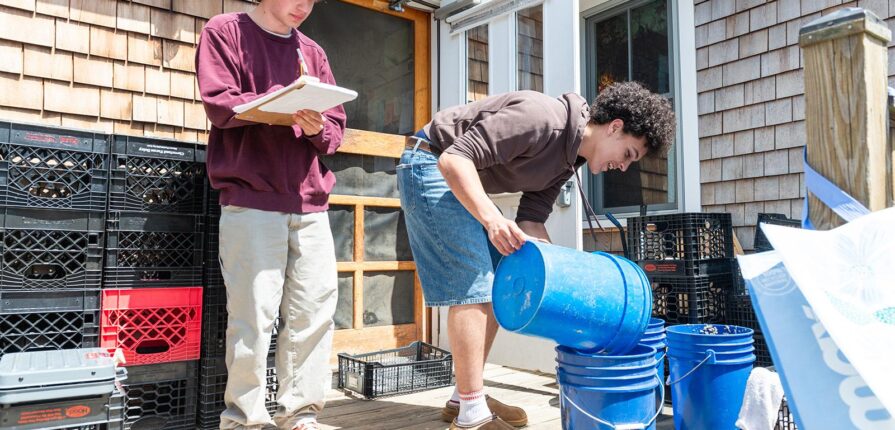
It’s a Friday afternoon and the blue compost bucket at the Martha’s Vineyard Public Charter School is filled with scraps of lunch, a slurry of potatoes, scrambled eggs and salad that will soon feel and smell like soil.
This spring, the charter school installed a food waste recycler, a machine that processes food scraps into a soil additive. Other institutions are close behind them, including multiple schools and four Island towns.
At the Oak Bluffs, West Tisbury, Chilmark and Aquinnah town meetings in April and May, residents overwhelmingly approved funding for municipal food waste recyclers which will soon be installed at town transfer stations and local drop offs. Edgartown is also applying for a state-grant to install a recycler at its transfer station.
While dozens of other municipalities in Massachusetts have composting programs, the Island’s towns are among the first in the state to vote for municipally-owned and operated food waste recyclers, helping to fill the vacuum of food waste management in the absence of large-scale, permanent composting solutions on the Island.
“It’s no secret that we need this,” said Sakiko Isomichi, the climate resilience planner at the Martha’s Vineyard Commission.
Food waste makes up 34 per cent of all waste produced on the Vineyard, and some estimates put that number even higher, according to a 2017 study on Island food waste management commissioned by the MV Vision Fellowship, a Vineyard nonprofit that funds environmental and social sustainability initiatives.
Read full article and see more pictures on the Vineyard Gazette…

